Guy Lavoie
Members
-
Joined
-
Last visited
Everything posted by Guy Lavoie
-
Oh yes, higher up usually means better communications.
-
Today I got to do the test of putting it out near the pool. Same results as with the garage: it works, with the odd update delay every now and then. I do like that it does what's needed to get through, repeats or whatever. I also did a bit of Google searching on the subject of Zwave LR vs Yolink, and the general consensus seems to be that Yolink beats out LR on the reliable long range communications.
-
Are you able to ping it's IP address? Does it appear in your router's device table?
-
No, the intent of the new thread is to discuss the performance of LR (once you get it working). My first post will give you the idea)
-
Thing is, when you create a new spoken, the first thing you select is the node. It's the root pointer that everything else is related to. That's probably why it can't be changed.
-
Since you can log in by admin console, you could try redoing the upgrade from there.
-
Welcome to the LR camp! Now you can share your experiences in the LR thread I just started 🙂
-
Then I'd open a ticket.
-
Polisy upgrades can sometimes need a second reboot to finalize correctly. Try power cycling it.
-
Different node names usually means needing to redo things. Alexa or Google home can't know what old name = the new name.
-
Since Z-Wave Long Range functionality is still new, I thought I'd start this thread where we can share observations and notes, about how it's working (or not) for you. This is after you get it working and successfully add LR device(s). Here are my notes so far, including my initial observations first reported in the ZMatter dongle firmware update thread (and lets keep using that thread for "getting it to work". Testing of LR range: a bit disappointing. I don't know how this compares to a Yolink device, but going through concrete foundation walls seems to really limit range. I first tried my Shelly LR device where I usually plug in my pool pump, which is the corner of my property. Two inside walls, two concrete foundation walls (the house has been expanded) and through two walls of an aluminium above ground pool. Total distance, about 80 feet. No go. Next was in the standalone garage, which subtracts the two pool walls but adds steel cladding on the garage, About 60 feet. No go. Next was inside the basement workshop, which brings it down to just the two inside walls and one concrete foundation wall. That works. Now I'm testing this with my trusty test Polisy, which is near my computer in the basement, and the dongle is at desktop level. I suspect that moving the dongle higher up, ideally above ground, would help. I'll test that when I implement the LR function on my production eisy, it's dongle is almost at ground level. Update: I now deleted the Shelly device from my test Polisy and added it my production Eisy. The dongle antennas on that one are higher, just below the ground floor joists. I retested the garage location as described above. The higher dongle location eliminates the need for the signal to go through foundation walls. It now works, but there is sometimes a delay (up to a couple of seconds) before the on or off status updates in eisy-ui when I send a command. So LR is likely doing some kind of retry on communications. The same module responds immediately when it's closer to the dongle. I'll be retrying the pool location later. The pool location is interesting because I also have a Yolink hub near my ZMatter dongle, and a Yolink temperature sensor at the same pool location. It's been quite reliable though not perfect. This will allow me to compare how well the two long range technologies work.
-
I understand your frustration. Technology is great, when it works. Just a thought (and something to try): try turning off "Secure Inclusion" in the Z-Wave screen, and retry adding it again to see if that succeeds. You could also try changing the Communication Speed and Interview timeout settings.
-
Hah, I noticed that too. It seems to indicate the "On" percentage of my entire system! Not sure if it's really meant for some unspecified purpose. An idea of your home's energy consumption?
-
Have you tried a different LR device, if you have one on hand?
-
The only difference left compared to mine is that I also turned on the fast communications feature. You could give that a try.
-
No, I meant in the dongle upgrade screen, that I posted above. Is the Z-wave Long Range box checked? Ah sorry, I hadn't seen the video (I was outside just reading your post on my phone). Looks like it's set ok. Do you have another, different LR module you could try?
-
Ahh nice, you learn something every day 🙂 Thanks! Cleanup done!
-
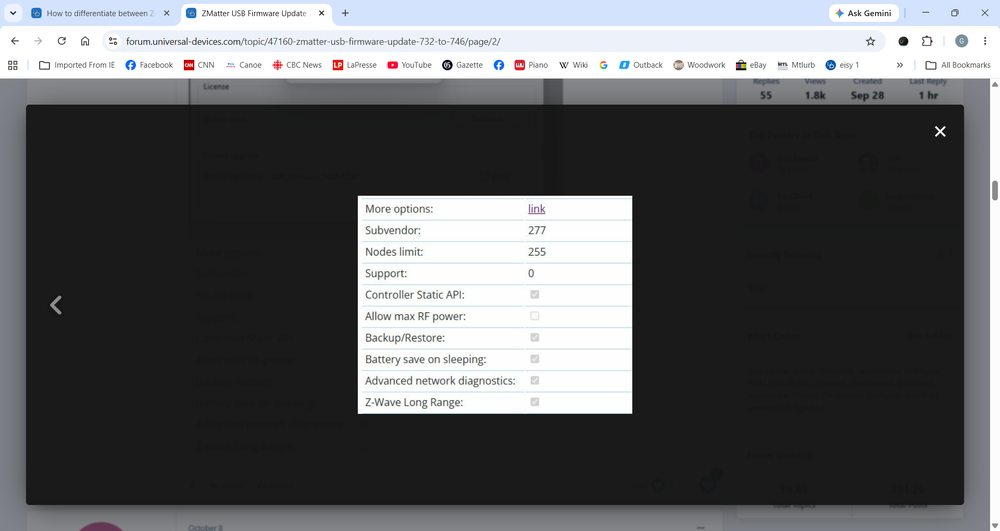
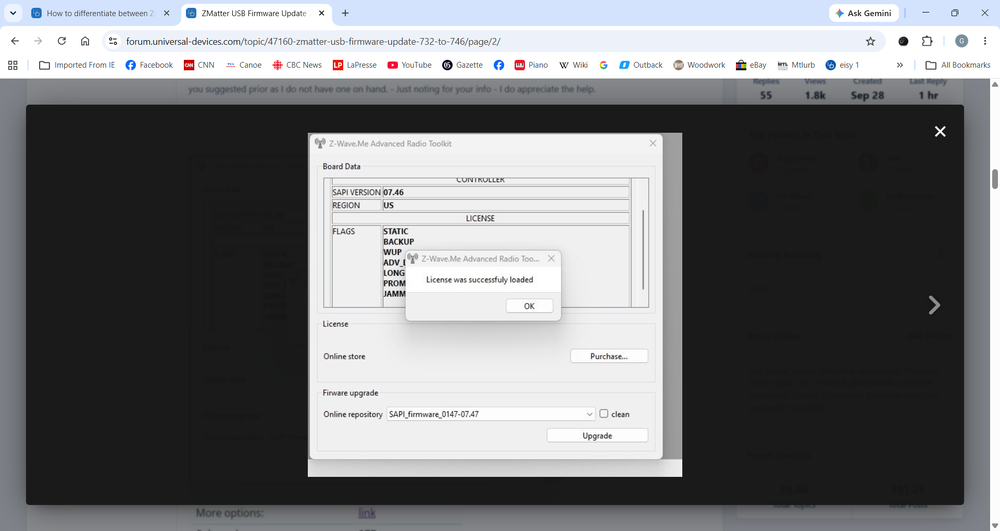
Ok, just to make sure nothing got looked over. The Long Range box was checked after you finished the dongle upgrade process, right? Did you end up needing to use the Zsniffer tool to enable it?
-
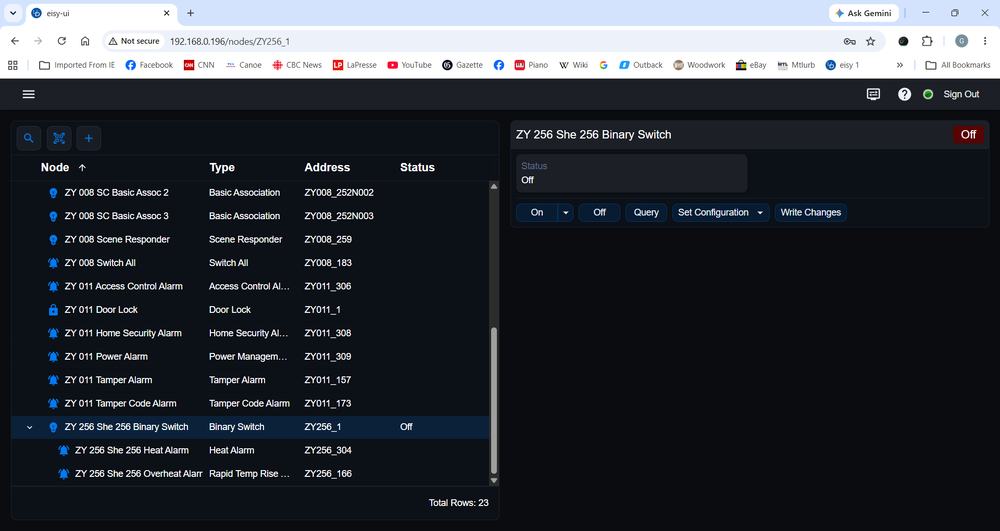
One thing I noticed in experimenting with Z-Wave LR is that for the LR device, the node list shows only the main node by default, with an expandable "subfolder" of the other nodes. I like that. Keeps the node list cleaner. It would be great if eisy-ui did this for other multi node devices, like Z-Wave locks. Below is the screen of my test Polisy, showing the difference between the two. The LR device is showing the secondary nodes as expanded. The lock (ZY 011) would be much nicer with only the main node showing by default and the other 5 nodes in a folder under it. Same with ZY 008.
-
Not that I know of.
-
As you have found out, "Long Range" is actually describing the time and effort needed to get it working... But have you properly factory reset the device you're trying to add first? I had previously added my Shelly device as a regular mesh device, and doing a ZWave exclude wasn't working, So I ended up factory resetting it (pressing the button on it while plugging it in). The fact that the LR radio button is on by default would indicate that your dongle configuration is correct.
-
Is the LR now working?
-
For the procedure, read the forum thread I referenced earlier. Pay attention to the posts written by me and @junkycosmos . For using a Mac, you'll have to figure out the equivalences on your own. @Javi mentions having used a Mac. Read the whole thread before getting started.
-
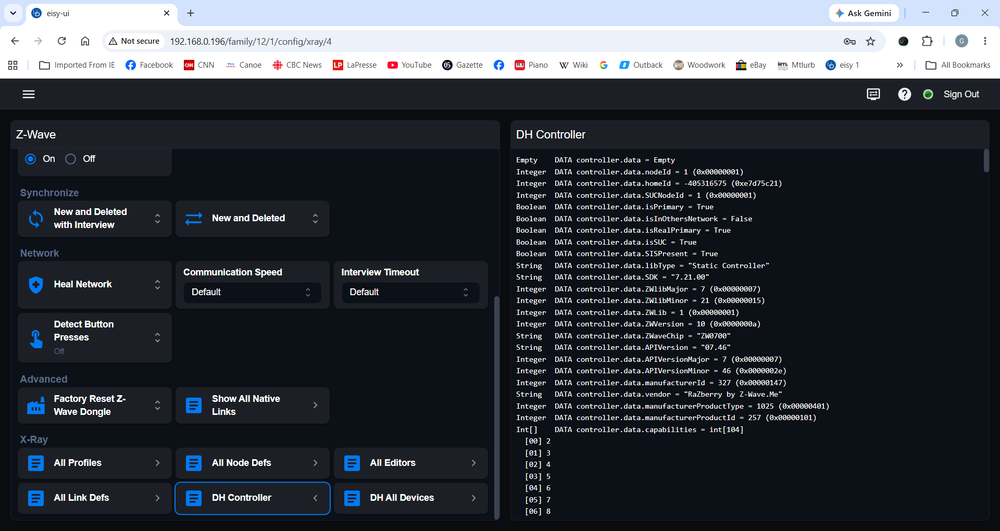
Yes. If it was never updated, your ZMatter dongle is very likely at firmware 7.32. You can see the version in eisy-ui by going into the Z-Wave menu and clicking on X-Ray -> DH Controller. Here's mine after the update, see how the APIVersion = "07.46"
-
The biggest indication of LR operation is the node number. It should start at 256. I don't know what your Zwave dongle is, I have the ZMatter, so node names are prefixed with ZY. My first (and only) LR device thus has node name ZY256. But you would have to have included it as a LR device, with some setting up. Notice how the Zwave setup screen below shows the Z-Wave Region as US LR: Then there is the dongle firmware update and everything else that needs to be done: